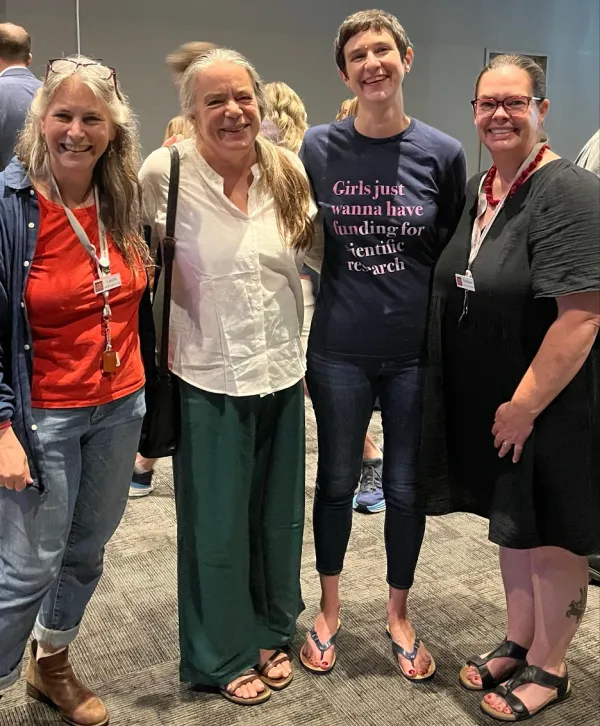
Dr. Shari Speer, OSU’s preeminent psycholinguist, has decided to retire.
Since receiving a PhD in Human Experimental Psychology from the University of Texas at Austin in 1988, Dr. Speer has had a very fruitful career resulting in over 100 credited publications and a far-reaching impact on the field of Psycholinguistics, especially in the area of prosodic processing. She advised and funded numerous graduate students and postdocs, and many of her advisees have gone on to take faculty positions in universities the world over. She has received notable awards, including election as a Fellow of the American Association for the Advancement of Science and the 2020 President and Provost’s award for Distinguished Faculty Service. She served not only as Professor of Linguistics but also as Department Chair for Linguistics, Associate Dean of the Graduate School and Associate Dean for Faculty Affairs in the College of Arts and Sciences.
In her role as department chair, Shari had the unique challenge of overseeing the complete remodeling of Oxley Hall. This involved moving all department operations temporarily to rooms inside the ‘Shoe and working with the architects to develop the department facilities. One such facility is the sociolinguistics sound-proof living room, one of very few spaces of its kind in the country. Shari was always happy to support everyone in the department and continued her support and mentorship from her dean roles in the Graduate School and the College. As dean, Shari used her passion for helping others to guide them through the university system. Despite the added distance from Oxley Hall, she never failed to help any linguist in need. Dr. Speer also served as the chair of the Social and Behavioral Institutional Review Board and was responsible for focusing the IRB’s efforts on developing a culture which prioritizes both institutional support for the conduct of research and each researcher’s individual ethical responsibility to their research subjects.
“Everybody really respected her — she took both the faculty research side and the administrative side of the job seriously. (IRB Chair) was a horrible, thankless job that took tons of time and effort, and she did it well in a way that helped lots of people.”
- Laura Wagner, Professor, Developmental Psychology

Shari was the department chair when the COSI Language Pod was getting started, and she was instrumental in its success. One of her greatest abilities in this endeavor was to explain science in a way that the average person could understand. One such communication success came from Shari’s idea to promote eye-tracking in the Language Pod. This gave the unique opportunity to create a live display of the tracked eyeballs during experiments in the Pod. The massive screen displaying a close-up of a participant’s eye certainly added to the mystique of the language pod and led to many passers-by taking an unavoidable interest. Shari also found glass heads upon which to display the eye tracking camera headgear when not in use. The combination of giant eye images and glass heads sounds like something out of a sci-fi movie, but it fit in perfectly at COSI and added a great feeling of excitement.
“As a colleague, she was an outstanding mentor and role model to junior faculty, providing thoughtful advice about research, grants-getting, graduate student mentoring, and leadership.” - Cynthia Clopper, Distinguished College Professor, Linguistics
Beyond all titles and teaching, Shari had a massive impact on the culture of the linguistics department. Her lab, SpeerLab, had a very open research culture, such that it attracted people from other colleges and departments, far beyond what would traditionally be considered psycholinguistics. SpeerLab had a reputation as a forum where anybody could come to get feedback on their experimental designs and procedures, and as being very welcoming to newcomers. Despite the meeting time of Friday morning at 9am, SpeerLab was always a bustling lively bunch with fun and useful discussions.
“That kind of sums up Shari: she's always been willing to take on hard tasks if that will improve the community.”