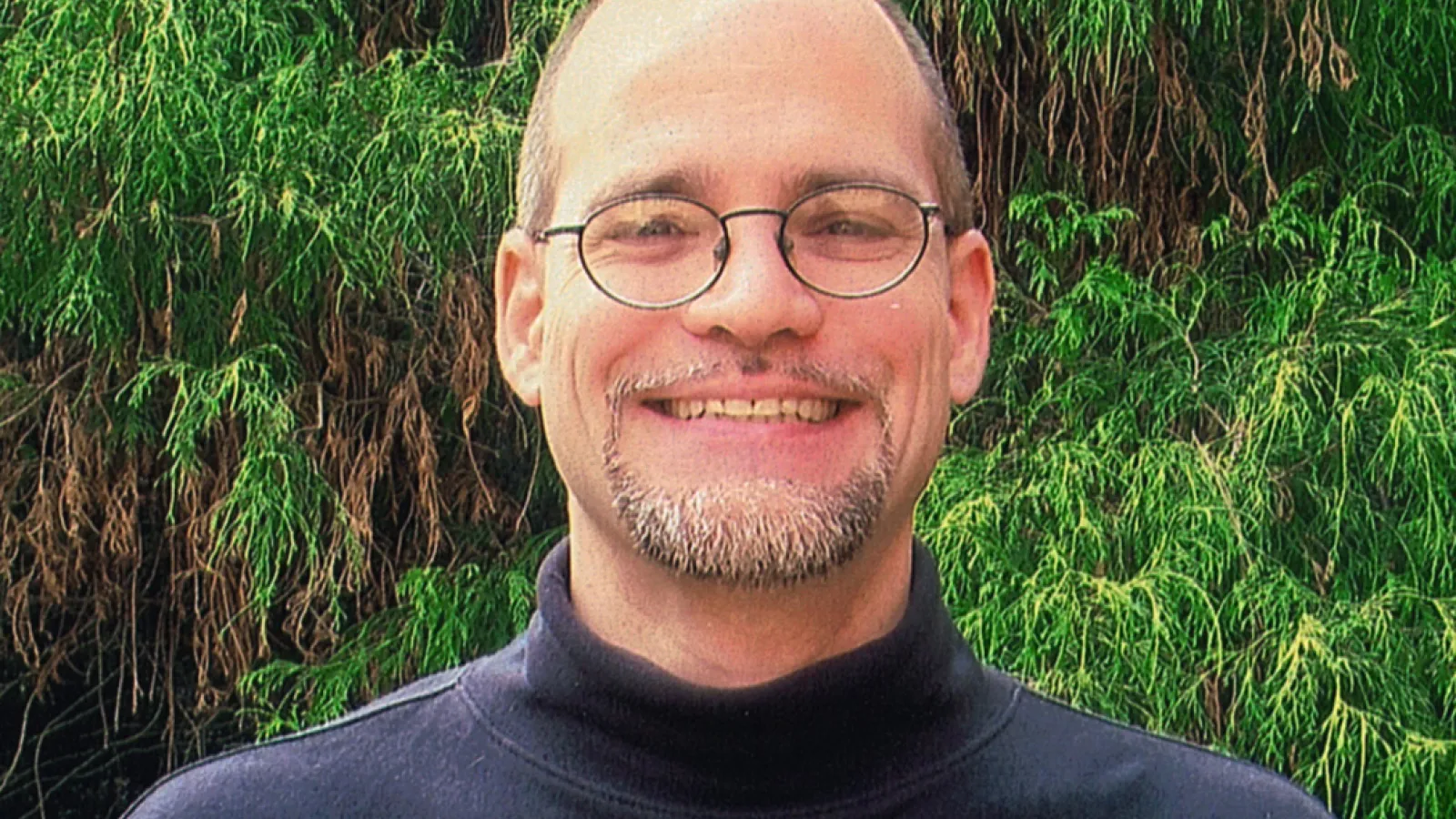
William Schuler selected as College of Arts and Sciences Distinguished Professor
While the chair normally has the honor of sharing good news with the department and our broader community of linguists, in this case I’m sharing the news (on behalf of the awards committee) as the good news concerns the department chair himself!
We have just learned that Professor William Schuler has been selected as a College of Arts and Sciences Distinguished Professor. This title serves to honor professors who have excelled in teaching, service, and research/creative activity, and whose work has demonstrated significant impact on their fields, students, college, university, and/or the public.
Beyond his successful research impact, William’s nomination also recognizes his service to the department and his record as an instructor and mentor. Through his leadership—including his role in onboarding and hiring multiple outstanding junior faculty hires and facilitating multiple faculty promotion cases—the department has maintained its strong national and international standing as among the very best linguistics programs around (consistently located in the top 10 linguistics programs in the US and in the top 20 to 25 in the world in the annual Quacquarelli-Symonds rankings). And in his role as a mentor, all his external letter writers recognized his impact on students who have gone on to positions at top universities and industry labs, including Cornell (Marty van Schijndel), Stanford (Cory Shain), NTU Singapore (Byung-Doh Oh), Meta (Lifeng Jin) and Amazon (Manjuan Duan).
Regarding his research, while it is somewhat difficult to quote from the letters of support without revealing the identities of the letter writers, here are some statements that indicate the strength of support he received in these letters:
• I have been following Professor Schuler’s work for the last fifteen years, and have had the opportunity to review several papers co-authored by him. Over these fifteen years, Professor Schuler has developed a unique research program in the area of psycholinguistics. He is one of only a handful of scientists in the world who develop computationally implemented models of sentence processing. This kind of work is extremely rare in psycholinguistics because it requires a deep knowledge of computer science (subsuming artificial intelligence and machine learning), psychology, linguistics, and statistics. Such interdisciplinary work has historically been the main driver of the biggest achievements and breakthroughs in the field. For these reasons, he is a very important figure in the field of psycholinguistics.
• Dr. Schuler works on many aspects of language processing. One paper that got my lab’s attention a few years ago is Rasmussen & Schuler (2018) published in the journal Cognitive Science. This is an underappreciated gem of a paper, where Schuler and his student (at the time) Rasmussen proposed a parsing framework which was implemented within a cognitively motivated distributed model of memory. This framework provides an algorithmic-level (in the sense of Marr) account of the processing difficulty associated with center-embedded sentences, across a range of structures (showing e.g., that the effects are distinct from difficulty associated with ambiguity resolution). This is an ambitious and thorough paper with important insights for how language processing might be implemented in the mind and brain.
• As you are no doubt aware, research involving language has been revolutionized over the last decade by the advent of deep learning and then large language models (LLMs). […] Prof. Schuler, in work with student Byung-Doh Oh, has exemplified what it means to do thoughtful work in this rapidly evolving context, with highly impactful results. Notably, they have done extensive and careful work showing that you do not get better modeling of human processing, as measured by reading behavior and brain imaging, by using the biggest and best LLMs, and in fact the standard measures of LLM quality are inversely correlated with how well they fare with regard to cognitive predictions in large scale studies. Although this is quite counterintuitive, the results are utterly convincing and as a result most people working in this space—my students and I included—now make use of earlier, smaller models in our cognitive work, even if the newer and larger models can outperform them in practical applications. In an excellent piece of work, Oh, Yue, and Schuler (2024) have demonstrated through careful analysis that the problem lies in the models being too good at making accurate predictions when lower-frequency words are involved. By training that incorporates more text than any individual human being could ever hope to read, they acquire superhuman predictive capabilities, and that makes them worse at predicting what’s happening in individual human brains.
Congratulations, William